High-current DC power for copper, gold, silver, lithium, cobalt and critical mineral recovery — scalable from hundreds to tens of thousands of amps.
Electrowinning is the electrochemical recovery of metals from leach solutions. The process passes high DC current through an electrolyte between inert anodes and cathode blanks, depositing pure metal onto the cathodes. Copper electrowinning typically operates at 200–400 A/m² cathode current density and just 2–3V per cell. With tankhouses containing hundreds of cells wired in series, total circuit voltages remain low (typically 3–6V DC) but current demands are enormous — 10,000A to 60,000A or more for a single rectifier circuit. The power supply must deliver massive, stable DC current with minimal voltage drop across busbars and connections.
In electrowinning, current efficiency — the percentage of electrical energy that actually deposits metal rather than generating heat or side reactions — directly determines the cost per tonne of recovered metal. Copper electrowinning typically achieves 85–92% current efficiency under optimal conditions. Every percentage point of efficiency loss translates to increased energy consumption per tonne (typically 1,800–2,200 kWh/t for copper). The rectifier’s output quality, particularly ripple content and regulation accuracy, is a major determinant of current efficiency. Clean, stable DC maximises faradaic efficiency and minimises parasitic reactions.
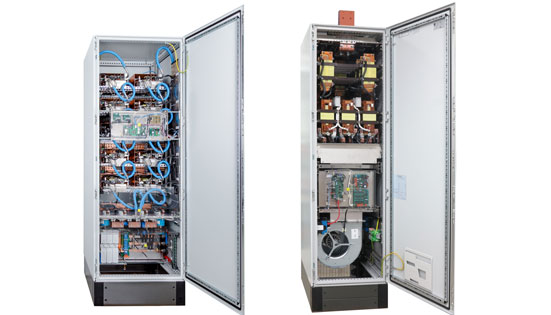
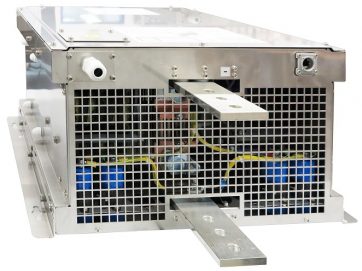
Mining and refining operations require rectifier systems that scale with production capacity and integrate into plant-wide control networks. Parallelable IGBT rectifier cabinets allow operators to add capacity incrementally as throughput grows. Industrial communication protocols — Profinet, PROFIBUS, Modbus TCP, and OPC-UA — enable the rectifier to report real-time current, voltage, power consumption, and fault status to SCADA systems. Water cooling is essential at high current levels, providing reliable thermal management in harsh tankhouse environments with ambient temperatures of 40–65°C and corrosive acid mist.
Typical operating parameters for copper electrowinning. Values vary by metal, electrolyte chemistry, and tankhouse configuration.
| Parameter | Typical Range | Notes |
|---|---|---|
| Current Density | 200 – 400 A/m² | Copper EW: 250–350 A/m²; gold/silver: lower density |
| Voltage Range | 0 – 6V DC | Per cell: 2–3V; series circuits typically 3–6V total |
| Ripple Tolerance | < 1% (IGBT) | Directly affects current efficiency and cathode quality |
| Temperature | 40 – 65 °C | Ambient tankhouse conditions; water cooling essential |
| Current Efficiency | 85 – 92% | Higher efficiency = lower kWh per tonne of metal recovered |
| Power Consumption | 1,800 – 2,200 kWh/t | Copper electrowinning; varies with current efficiency |
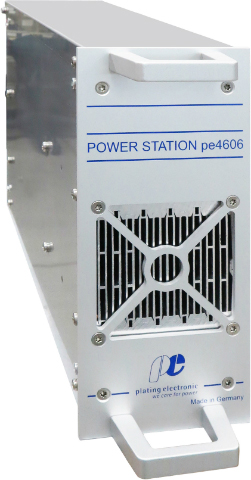
Scroll through our recommended units for electrowinning applications — from pilot-scale mineral recovery to full-production tankhouse installations.
In electrowinning, ripple directly impacts cathode quality, current efficiency, and energy costs. The economics are compelling at scale.
Low ripple produces smooth, dense cathode deposits with minimal dendritic growth, nodules, and entrapped electrolyte. High ripple causes periodic current surges that promote rough, porous deposits requiring additional refining. For LME-grade copper cathode (99.99% Cu), clean DC power is essential to meet purity specifications consistently.
Ripple-induced current peaks exceed the optimal deposition rate, wasting energy on hydrogen evolution and electrolyte heating rather than metal deposition. Reducing ripple from 5% (SCR) to <1% (IGBT) can improve current efficiency by 2–4 percentage points — translating to significant energy savings at 10,000A+ production scale.
At mining scale, energy is the largest variable cost in electrowinning. A large-scale copper EW circuit consuming 2,000 kWh/t at 90% current efficiency produces approximately 100 tonnes per day. A 3% improvement in current efficiency from better ripple control saves roughly 60–70 kWh/t — over $500,000 per year in energy costs at typical Australian industrial power rates.
High ripple accelerates lead anode corrosion and increases acid mist generation, raising maintenance costs and environmental compliance burden. IGBT rectifiers with <1% ripple extend anode life by 15–25%, reduce acid mist extraction requirements, and lower the frequency of anode replacement campaigns — a major operational cost in large tankhouses.
Tell us your metal, target production rate, cell configuration, and site conditions. Our technical team will recommend the right rectifier system, busbar sizing, and control architecture — free of charge.
Request a Quote