HomeApplicationsBattery Formation

Battery Formation

Programmable DC power for lead-acid, lithium-ion, and industrial battery plate forming, charging, and testing — with precise current/voltage profiling and amp-hour metering.

Programmable
Pulse Capable
Amp-Hour Metering
Application Requirements

What Battery Formation Needs
from a Power Supply

Plate Formation and Activation

Battery formation is the electrochemical process that converts raw pasted plates into active positive and negative electrodes. For lead-acid batteries, this involves passing controlled DC current through the plates immersed in dilute sulfuric acid to form lead dioxide (PbO₂) on the positive plate and sponge lead (Pb) on the negative. The process typically requires multi-step current profiles — an initial low-current soak to establish the crystal structure, followed by higher-current bulk formation, and a finishing stage at reduced current. Each step must be precisely controlled in both current magnitude and duration (amp-hours delivered) to ensure complete conversion of the active material without overheating or gassing damage.

Current Profiling and Amp-Hour Control

Formation quality is directly linked to the accuracy of the charge profile. The rectifier must support constant-current (CC), constant-voltage (CV), and combined CC/CV modes with programmable transitions between stages. Amp-hour totalisation with better than ±1% accuracy is essential — under-formed plates lack capacity, while over-formed plates waste energy and accelerate grid corrosion. Modern formation systems require the rectifier to execute complex multi-step recipes automatically, with each step defined by target current, voltage limit, amp-hour cutoff, and temperature-based derating. Data logging of every formation cycle provides the traceability that battery manufacturers need for quality assurance and warranty compliance.

Pulse Formation and Temperature Management

Pulse and pulse-reverse formation is increasingly adopted for both lead-acid and lithium-ion battery manufacturing. Periodic current interruption or reversal during formation allows gas bubbles to dissipate from the plate surface, improves electrolyte mixing within the plate pores, and produces a more uniform crystal structure. The result is higher initial capacity, better cycle life, and reduced formation time — typically 15–25% shorter cycles compared to constant-current methods. Temperature monitoring is critical throughout: excessive heat during formation degrades the separator material and accelerates grid corrosion. The rectifier must integrate with temperature sensors and automatically derate or pause the cycle if plate temperature exceeds safe limits.

Key Requirements
Programmable CC/CV/Pulse current profiles via pe280
Amp-hour totalisation with ±1% accuracy
Low ripple for uniform plate crystal structure
Pulse reverse capability for faster, higher-quality formation
TCP/IP data logging for full cycle traceability
Temperature monitoring with automatic derating
Technical Parameters

Battery Formation Process Specifications

Typical operating parameters for lead-acid and lithium-ion battery plate formation and charging systems.

Parameter Typical Range Notes
Current Range 10 – 3,000A Per circuit; multiple circuits per formation line
Voltage Range 0 – 48V DC Lead-acid typically 2.5–3.0V/cell; lithium 3.6–4.2V/cell
Current Profiles CC / CV / Pulse Multi-step programmable; automatic transitions on Ah or voltage trigger
Amp-Hour Accuracy ± 1% Critical for consistent plate conversion and capacity
Temperature Monitoring PT100 / thermocouple Automatic derating or cycle pause on over-temperature
Cycle Programming Up to 16 steps Each step: current, voltage limit, Ah cutoff, time limit, ramp rate
Data Logging TCP/IP / RS485 Per-cycle logging of V, I, Ah, temperature, time for QA traceability
Recommended Products

Rectifiers for Battery Formation

Scroll through our recommended units for battery plate formation, charging, and testing applications.
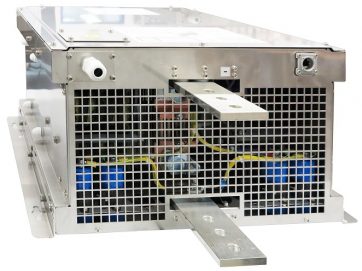
PE 3000 Series
PE 3000 Series
10A – 3,000A · Programmable via pe280
IGBT switchmode rectifier with full multi-step programming via the pe280 digital controller. Supports CC, CV, and timed stages with amp-hour cutoffs. RS485 communication for PLC integration and recipe management. The workhorse choice for lead-acid and lithium-ion formation lines.
Primary Pick View Product →
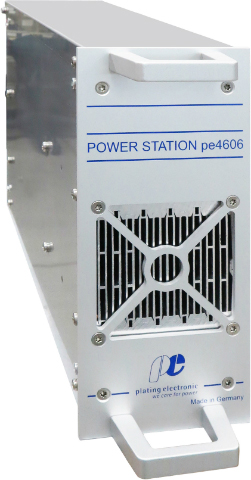
PE 4000 Series
PE 4000 Series
20A – 2,200A+ · TCP/IP data logging
High-current rectifier with TCP/IP networking for comprehensive per-cycle data logging. Records voltage, current, amp-hours, and temperature at programmable intervals — providing the traceability battery manufacturers require for QA compliance. Parallelable for high-capacity formation rooms.
Primary Pick View Product →
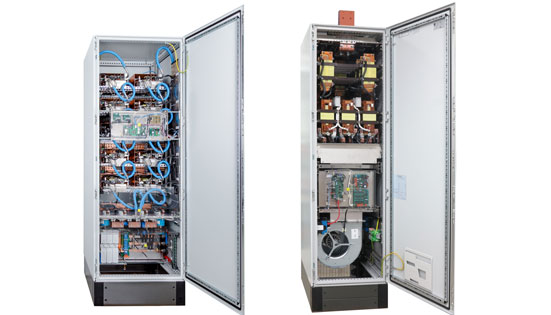
Pulse Reverse Systems
Custom waveform · 1–16 pulse steps
For advanced pulse formation where periodic current interruption or reversal improves plate crystal structure, reduces formation time by 15–25%, and increases battery cycle life. Programmable pulse frequency, duty cycle, and reverse amplitude for optimising each battery chemistry.
Specialist View Product →
Technical Deep Dive

Why Ripple Matters
in Battery Formation

Output ripple directly impacts plate quality, capacity consistency, and production yield in battery manufacturing.

Plate Formation Quality

Low-ripple DC produces a uniform, fine-grained crystal structure in both lead dioxide and sponge lead active materials. High ripple causes periodic over- and under-current conditions that create mixed crystal phases, leading to uneven plate conversion. Incompletely formed regions become inactive “dead zones” that permanently reduce battery capacity.

Consistent Capacity

Battery manufacturers specify tight capacity tolerances — typically ±3% across a production batch. Ripple-induced formation inconsistency is one of the primary causes of capacity scatter. Reducing rectifier ripple from 5% to below 2% typically narrows the capacity distribution by 30–40%, significantly reducing the number of cells that fall outside specification.

Reduced Scrap Rates

Plates formed with high-ripple power supplies show higher rates of shedding, sulphation, and premature grid corrosion during accelerated life testing. These defects are often not detected until final test, resulting in scrapped finished batteries. Low-ripple IGBT formation rectifiers consistently deliver scrap rates 40–60% lower than equivalent SCR-powered lines.

Battery Cycle Life

The crystal structure established during formation determines the battery's entire service life. Well-formed plates with uniform, fine-grained active material deliver more charge/discharge cycles before capacity falls below end-of-life threshold. Batteries formed on IGBT rectifiers with sub-2% ripple routinely achieve 10–15% more cycles than those formed on SCR equipment.

Specification IGBT Switchmode SCR / Thyristor
Output Ripple < 2% 5 – 10%
Amp-Hour Accuracy ± 1% ± 3 – 5%
Capacity Scatter ± 2% ± 5 – 8%
Cycle Programming 16 steps, auto Manual / limited
Formation Scrap Rate < 1% 2 – 4%
Case Study

Proven in Production

Battery Manufacturing — Formation Line Upgrade
Battery manufacturers across Australia and the Asia-Pacific region use our PE 3000 and PE 4000 series rectifiers for plate formation. Upgrading from SCR to IGBT switchmode technology has delivered measurable improvements in capacity consistency, reduced scrap rates, and shorter formation cycle times. Contact us for details on installations relevant to your battery chemistry and production volume.
Read Case Study →

Spec a System for Battery Formation

Tell us your battery chemistry, plate count, and formation recipe. Our technical team will recommend the right rectifier, current profile, and data logging configuration — free of charge.

Request a Quote
AR Technical Support
Online
Hi! I see you're looking at battery formation power supplies. I can help with rectifier selection, formation profile design, or technical specs. What battery chemistry are you working with?
Lead-acid formation
Lithium-ion
Pulse formation
Amp-hour control