HomeApplicationsAnodising

Anodising

Precision DC power for Type II, Type III hard anodising, and colour anodising with pe8705 automatic colour sequencing control.

< 1% Ripple
10A – 3,000A
pe8705 Colour Control
Application Requirements

What Anodising Needs
from a Power Supply

Oxide Layer Formation and Current Control

Anodising is an electrolytic passivation process that grows a controlled aluminium oxide layer on the workpiece surface. Unlike electroplating, the workpiece is the anode. The oxide thickness, hardness, and porosity are directly governed by current density, voltage, and process time. Type II sulphuric acid anodising operates at 1.5–3 A/dm² and 15–21V, producing 5–25 µm oxide layers suitable for architectural and decorative finishes. Type III hard anodising demands higher current densities of 3–6 A/dm² at 25–80V with refrigerated baths near 0°C, producing dense, wear-resistant coatings of 25–150 µm. The rectifier must deliver stable, regulated DC with precise current-density control across these ranges to ensure uniform oxide growth over complex part geometries.

Temperature and Voltage Interaction

Bath temperature is critical in anodising. Sulphuric acid dissolves the oxide layer at a rate that increases with temperature, so the balance between oxide formation (driven by current) and dissolution (driven by temperature) determines final coating properties. Hard anodising requires near-freezing electrolyte temperatures (0–5°C) to minimise dissolution and achieve dense, hard coatings. The rectifier must accommodate the higher voltages needed to push current through thick, resistive oxide layers as they grow — requiring a voltage range of 0–28V or higher with seamless crossover from constant-current to constant-voltage regulation.

Colour Sequencing with pe8705

Electrolytic colour anodising uses alternating current or modified DC waveforms to deposit metallic pigments (tin, cobalt, nickel) into the porous oxide structure. The pe8705 colour sequencing controller automates multi-step colour processes by programming current amplitude, polarity, and timing for each colour step. This eliminates operator error in batch-to-batch colour matching and enables repeatable production of bronze, black, champagne, and custom architectural finishes. The pe8705 integrates directly with PE 3000 series rectifiers via digital bus, managing up to 16 sequential process steps with programmable ramp rates, hold times, and transition profiles.

Key Requirements
<1% ripple for uniform oxide layer growth and hardness
Precise current density control: 1.5–6 A/dm²
pe8705 colour sequencing for automated multi-step processes
0–28V range for hard anodise voltage ramp-up
CC/CV crossover for growing oxide layer resistance
Bath temperature monitoring integration (0–25°C)
Technical Parameters

Anodising Process Specifications

Typical operating parameters for sulphuric acid anodising processes. Values vary by alloy, part geometry, and finish requirements.

Parameter Typical Range Notes
Current Density 1.5 – 6 A/dm² Type II: 1.5–3 A/dm²; Type III hard anodise: 3–6 A/dm²
Voltage Range 0 – 28V DC Type II: 15–21V; hard anodise may require 25V+ as oxide grows
Ripple Tolerance < 1% (IGBT) Critical for oxide uniformity; high ripple causes soft, porous layers
Bath Temperature 0 – 25 °C Type II: 18–22°C; Type III: 0–5°C (refrigerated)
Acid Concentration 150 – 250 g/L H&sub2;SO&sub4; Higher concentration for hard anodise; lower for colour work
Process Time 15 – 120 min Type II: 15–40 min; Type III: 30–120 min for thick coatings
Colour Steps 1 – 16 programmable pe8705 manages current, timing, and polarity per colour step
Recommended Products

Rectifiers for Anodising

Scroll through our recommended units for anodising applications — from compact bench systems to full production-line colour anodising installations.
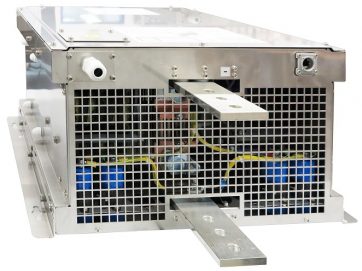
PE 3000 Series + pe8705
PE 3000 + pe8705 Colour Control
10A – 3,000A · 0–24V / 0–48V DC
The optimal combination for colour anodising. The PE 3000 delivers <1% ripple IGBT power while the pe8705 controller automates multi-step colour sequences — programming current, timing, and polarity for each colour step. Produces repeatable bronze, black, and champagne finishes batch after batch.
Primary Pick View Product →
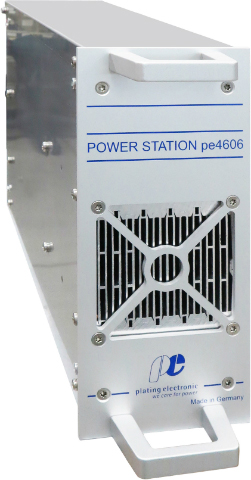
PE 4000 Series
PE 4000 Series
20A – 2,200A+ · Parallelable to any capacity
For large-format hard anodising lines requiring high current and wide voltage range. PROFIBUS and TCP/IP networking, full digital control via pe280, and seamless CC/CV crossover for managing growing oxide resistance. Ideal for aerospace and defence hard-coat anodising.
Primary Pick View Product →
PE 1000 Series
PE 1000 Series
50A – 600A · 0–18V DC
Compact IGBT rectifier for smaller anodising operations, job shops, and laboratory process development. Same <1% ripple quality as the larger units. RS485 communication and amp-hour totalisation for oxide thickness control.
Also Suitable View Product →
Technical Deep Dive

Why Ripple Matters
in Anodising

Output ripple directly affects oxide layer quality, colour consistency, and coating hardness. Here is what changes when you move from SCR to IGBT technology.

Oxide Layer Uniformity

Low ripple ensures consistent current delivery throughout the anodising cycle, producing a uniform oxide layer with even pore structure across the entire workpiece. High ripple creates periodic current fluctuations that cause localised variations in oxide thickness, resulting in uneven dye uptake, colour banding, and inconsistent hardness across the part surface.

Colour Consistency

Electrolytic colour anodising deposits metallic pigments into the porous oxide structure at rates highly sensitive to current waveform quality. Ripple above 2–3% causes uneven pigment deposition, producing visible colour variation between parts and across individual workpieces. With <1% ripple, batch-to-batch colour matching becomes repeatable and predictable.

Hard Coat Hardness and Wear Resistance

Type III hard anodise coatings derive their hardness (up to 70 HRC equivalent) from a dense, ordered oxide structure. Ripple-induced current fluctuations disrupt this structure, creating soft zones and micro-porosity that reduce wear resistance and corrosion protection. IGBT rectifiers with <1% ripple consistently produce harder, more uniform coatings than SCR alternatives.

Energy Efficiency

IGBT switchmode rectifiers convert AC to DC at over 93% efficiency versus 75–85% for thyristor designs. Anodising lines running extended hard-coat cycles of 60–120 minutes at high current densities benefit significantly from reduced energy consumption, lower cooling loads, and improved power factor — savings that compound across three-shift operations.

Specification IGBT Switchmode SCR / Thyristor
Output Ripple < 1% 4 – 8%
Efficiency > 93% 75 – 85%
Oxide Uniformity ± 2% thickness ± 8 – 15%
Colour Repeatability ΔE < 1.0 ΔE 3 – 5+
Hard Coat Hardness 65 – 70 HRC 55 – 62 HRC
Case Study

Proven at Scale

Anodising Case Study — Coming Soon
We are currently preparing a detailed case study featuring a multi-line anodising installation with pe8705 colour sequencing control. The study will cover system specification, colour matching performance, and energy savings achieved by upgrading from SCR to IGBT rectification. Contact our technical team for reference site information in the meantime.
Contact Us →

Spec a System for Anodising

Tell us your anodising type (Type II, III, or colour), tank dimensions, alloy, and required finish. Our technical team will recommend the right rectifier and control configuration — free of charge.

Request a Quote
AR Technical Support
Online
Hi! I see you're looking at anodising power supplies. I can help with rectifier selection, sizing, or colour sequencing setup. What type of anodising are you running?
Hard anodising
Colour anodising
Sizing help
Ripple explained