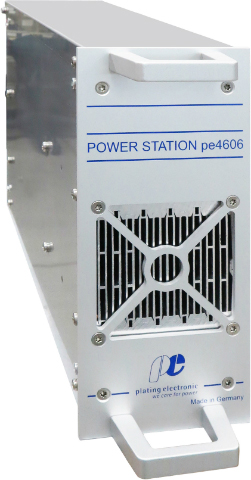
Precision DC power for stainless steel, aluminium and specialty alloy electropolishing — achieving mirror-finish surfaces with controlled material removal.
Electropolishing is the electrochemical reverse of electroplating. Instead of depositing metal onto a cathode, the workpiece is made the anode and material is selectively dissolved from the surface. Peaks and micro-burrs dissolve preferentially, producing a smooth, bright, passivated finish. The process requires precisely controlled DC current at relatively high current densities — typically 5–30 A/dm² — to maintain the viscous film (anodic film) that governs selective dissolution. If current density falls below the critical threshold, pitting occurs; if it exceeds the plateau region, gas evolution disrupts the film and produces an orange-peel texture.
Pharmaceutical, semiconductor, and food-processing industries demand electropolished surfaces for hygiene, corrosion resistance, and cleanability. Surface roughness targets of Ra < 0.4 μm are common, with some applications requiring Ra < 0.2 μm. Achieving these finishes consistently requires a rectifier that holds current density within a narrow window throughout the process cycle. Ripple in the DC output causes periodic fluctuations in the anodic dissolution rate, creating micro-waviness that increases Ra values and reduces the chromium-enriched passive layer thickness that gives electropolished stainless steel its superior corrosion resistance.
Electropolishing baths operate at elevated temperatures (40–80°C) with concentrated phosphoric-sulphuric acid electrolytes. As the bath heats during operation, conductivity changes and the rectifier must compensate automatically to maintain constant current density. Programmable current ramp-up prevents flash attack on thin sections, and timer functions ensure repeatable process times. For production environments, RS485 and TCP/IP interfaces allow the rectifier to integrate into automated handling systems where immersion time, current, and bath temperature are managed centrally.
Typical operating parameters for electropolishing processes. Actual values vary by alloy, electrolyte formulation, and target surface finish.
| Parameter | Typical Range | Notes |
|---|---|---|
| Current Density | 5 – 30 A/dm² | Stainless steel 10–25; aluminium 5–15; titanium 15–30 |
| Voltage Range | 0 – 18V DC | Most processes operate in the 6–14V plateau region |
| Ripple Tolerance | < 1% (IGBT) | Critical for surface uniformity; high ripple causes micro-waviness |
| Bath Temperature | 40 – 80 °C | Phosphoric-sulphuric acid baths typically 50–70°C |
| Process Time | 2 – 20 minutes | Depends on material removal target and surface condition |
| Surface Finish Target | Ra < 0.4 μm | Pharma/semiconductor: Ra < 0.2 μm; general: Ra < 0.8 μm |
| Automation Level | Manual to full PLC | RS485, TCP/IP interfaces; programmable ramp and timer functions |
Our recommended units for electropolishing applications — precision IGBT switchmode rectifiers delivering the clean, stable DC that mirror-finish surfaces demand.
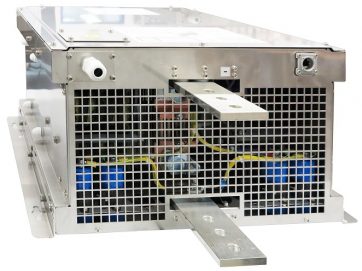
In electropolishing, output ripple directly impacts surface finish uniformity and material removal consistency. Here is what changes when you move from SCR to IGBT technology.
Ripple causes periodic fluctuations in the anodic dissolution current, creating micro-waviness on the polished surface. At 4–8% ripple (typical SCR), the current oscillates enough to cycle the surface between active dissolution and partial passivation, producing a visible texture that increases Ra values by 0.1–0.3 μm. IGBT switchmode rectifiers with <1% ripple maintain a stable viscous film for uniform, mirror-bright results.
Electropolishing removes a controlled amount of material — typically 10–25 μm per cycle. Ripple-induced current variation causes uneven material removal across the workpiece surface, with peaks and edges losing more material than recessed areas. This non-uniformity is particularly problematic for precision-machined components where dimensional tolerances are tight and wall-thinning must be predictable.
The chromium-enriched passive oxide layer formed during electropolishing is the primary reason the process is specified for corrosion resistance. Ripple disrupts the formation of this layer, producing a thinner, less uniform oxide with reduced chromium-to-iron ratio. For pharmaceutical and semiconductor applications where surface chemistry is as important as surface finish, low-ripple power is not optional — it is a process requirement.
IGBT switchmode rectifiers convert AC to DC at over 93% efficiency versus 75–85% for thyristor designs. In electropolishing, excess ripple also accelerates electrolyte decomposition and metal-ion build-up, shortening bath life and increasing chemical replacement costs. The combination of lower energy consumption and extended bath life typically delivers payback on the IGBT investment within 12–18 months.
Tell us your alloy type, tank dimensions, and target surface finish. Our technical team will recommend the right rectifier, current rating, and control configuration — free of charge.
Request a Quote